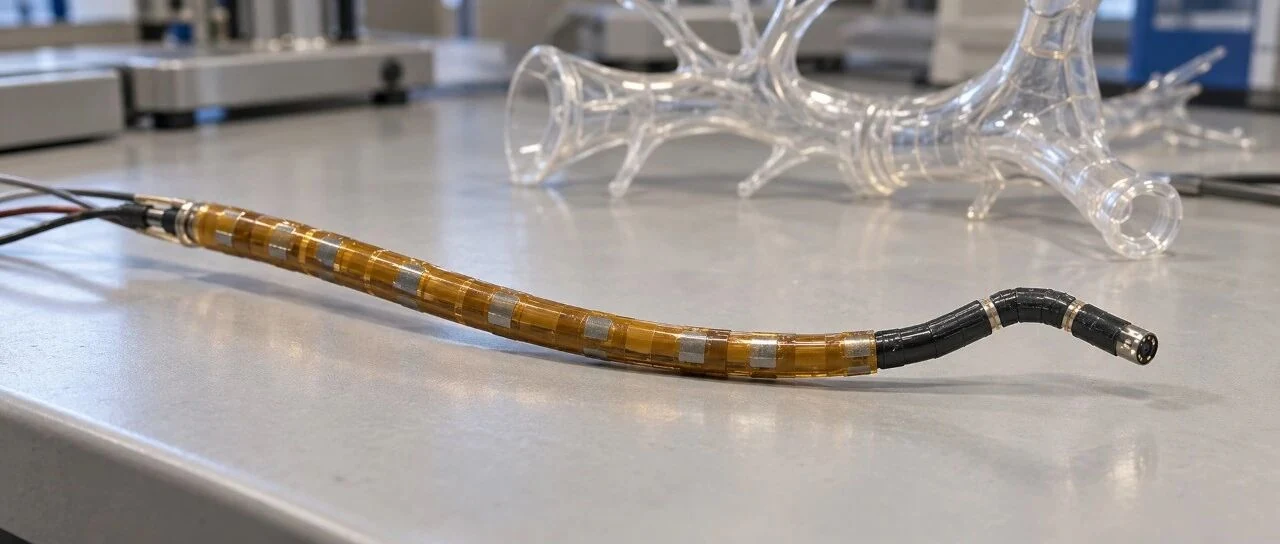
Sixty-four PVDF sensing units wrapped around a 5.2 mm scope body locate and measure sideways contact that the camera cannot see, holding R² above 0.98 per channel and responding in under 10 ms.
A bronchoscope is a camera on a flexible shaft. The camera looks forward. The shaft, which is what actually scrapes along the airway wall, is blind — the operator feels resistance through the handle and infers the rest. In the narrow branches where the instrument is most needed, that inference is the weak link.
Put the film where the contact happens
A team from Fudan University and the Shenzhen Institute of Advanced Technology, with Ningbo University, reported the fix in Science Advances on 7 October 2026: a 28 µm piezoelectric PVDF layer carrying 64 sensing units, screen-printed silver paste electrodes, encapsulated and wrapped conformally around the non-steering section of the shaft. Wrapping it costs 0.64 mm of outer diameter — from 5.20 mm to 5.84 mm, or 0.32 mm per side.
The channel layout is the design decision. Units are dense at the distal end, evenly spaced in the middle, and sparse proximally — a distribution borrowed from the ventral scales of snakes, and a direct statement that where a channel sits matters as much as how many there are.
What the calibration shows
Every one of the 64 channels was calibrated dynamically rather than at a single load:
- linearity R² above 0.98 on all channels, RMSE below 0.145 N
- contact response under 10 ms
- peak-response coefficient of variation under 2% across repeated loading
- signal close to baseline under passive, non-impact bending beyond 90°
That last item is the one that decides whether a wrapped film is usable. A conformal sensor bends whenever the instrument bends; if bending itself produces a force signal, the map is fiction. Bending to beyond 90° without a contact load leaves the reading near baseline, which is the minimum bar for trusting a reading taken inside a curved airway.
From measurement to action
The robot has two steering segments and four bending degrees of freedom. When measured contact reaches a preset 5 N, it decelerates and re-orients; alarm to completed adjustment took under 1.5 s including control and mechanical motion. In three explanted pig lungs and 27 navigation trials, contact force dropped below 3 N after adjustment, and post-procedure HE staining showed no mucosal abrasion, bleeding or tissue stripping.
The honest limits
The authors are explicit that 5 N is an engineering alarm threshold for this study, not a clinical safety standard. The work is bench and explanted-tissue only — sustained compression, friction damage over repeated passes, and behaviour in a living airway are untested. And the sensing mechanism has a structural consequence: a piezoelectric layer responds to change in load, so a steady sustained pressure produces a decaying signal. That is well suited to detecting contact events — which is exactly the job here — and unsuitable for holding a stable absolute pressure reading over minutes. A user who wants “how much pressure is on this spot right now” needs a different transduction principle, not a better PVDF film.
What transfers to industrial surfaces
Replace the scope with any slender curved body that must measure contact — a pipe being fed into a fitting, a tool shaft in a bore, a cable being pulled through a channel — and the problem is the same four constraints: conform without lifting, seal against the medium, tolerate bending without generating false load, and stay thin enough that the part still fits. The 0.32 mm per side radial cost is the constraint people underestimate. A 0.3 mm film plus encapsulation on a 5 mm shaft is a 13% diameter increase; on a 1 mm gap it does not fit at all.
Source: Pan, Q. et al., “Mitigating lateral sensing blind spots: a dual-segment bronchoscopic robot with a bioinspired skin”, Science Advances 12(41), eaeh9503 (2026). doi:10.1126/sciadv.aeh9503
我们做柔性压阻薄膜与 4096 点压力分布测量系统,正是为这类接触界面。