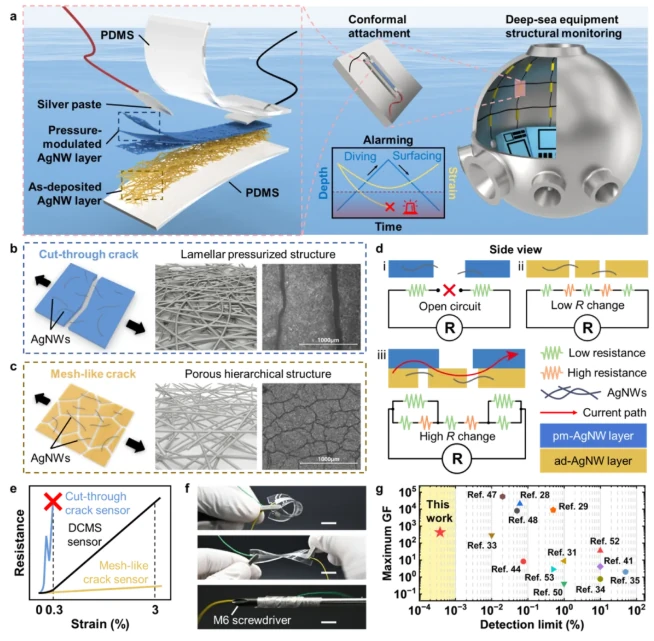
A dual-layer crack sensor from the Institute of Deep-sea Science and Engineering reaches a 3.365 µε detection limit with a gauge factor near 430, and still resolves capsule deformation inside a 50 MPa hydrostatic test.
A deep-sea capsule under load deforms by an amount that is easy to state and hard to measure. To put the scale in context: every 10 m of depth adds roughly 0.000625% strain. At those amplitudes the signal is smaller than the drift of the instrument that is supposed to record it, which is why hull and pressure-vessel monitoring still leans on discrete foil gauges placed where someone predicted the load would be.
Two crack networks instead of one
Crack-based resistive sensors have a trade-off baked in. Crack early and hard and the resistance change is large but the range is tiny; crack slowly and the range improves while the sensitivity at small strain collapses. A team at the Institute of Deep-sea Science and Engineering, Chinese Academy of Sciences, led by Yang Yang, published a structure that runs both at once in Nano Research.
Two silver-nanowire layers sit on a PDMS substrate. One is pressed dense (pm-AgNW): under small tensile strain it develops cut-through cracks that sever the main conductive path quickly. The other is left as-deposited and porous (ad-AgNW): it develops mesh-like cracks that trim a secondary path gradually. The two responses combine into a fast, stable rise in resistance at low strain. Fabrication is a one-step pressing process with patterned PI tape, silver paste and PDMS — deliberately no lithography and no vacuum deposition.
The reported numbers
- gauge factor around 430 over 0–3% strain, with a detection limit of 3.365 µε (0.0003365%)
- more than 5,000 tensile cycles at 0.5% strain, with hysteresis between 4.2% and 4.9% at the 200th, 1,200th and 5,200th cycles
- 864 hours of continuous immersion, with relative resistance change staying between −0.85% and +0.06%
- inside a 50 MPa hydrostatic test on a titanium capsule, signal-to-noise above 50 dB, tracking a commercial foil strain gauge across 10 MPa unloading steps
The 50 MPa figure is worth reading precisely. It is a laboratory pressure vessel, equivalent to about 5,000 m of water, not a dive. The sensor was bonded inside a titanium capsule and read the capsule’s compression, benchmarked against a mature foil gauge and finite element simulation. That is a narrower claim than “works in the deep sea”, and a more useful one: under pressure, a new thin-film device agrees with the instrument it would replace.
What it does not do
This measures in-plane strain in the substrate it is bonded to. It is not a pressure distribution sensor and cannot say where on a surface a load sits — a single number per channel, one axis. The 0–3% window is the whole specified range, so the high sensitivity applies in the small-strain regime and nowhere else. Long-term seawater corrosion, temperature coupling and packaging standardisation are listed by the authors as future work; 864 hours is 36 days, not a service life.
The part that matters for any film array
A 3.365 µε detection limit is only meaningful if the electronics can resolve it. The team built its own acquisition module — constant-current source, multiplexed channels, local storage, real-time clock — and reported noise and signal-to-noise per test phase rather than as one headline figure. That is the honest way to present a low detection limit, and it is the step most sensor announcements skip.
For anyone buying or specifying a film array on a large structure, the order of operations follows from this: put a strain gauge next to the array at commissioning, compare at several load levels, and keep the noise floor of the acquisition chain in the same conversation as the sensor’s sensitivity. A film that resolves a microstrain in the lab and is read by an amplifier with 20 µε of drift is a film that reports drift.
Source: Dai, Z. et al., “A universal and facile design strategy for ultrasensitive strain sensors with a 3.365 µε detection limit”, Nano Research (2026). doi:10.26599/NR.2026.94909123
我们做柔性压阻薄膜与 4096 点压力分布测量系统,正是为这类接触界面。