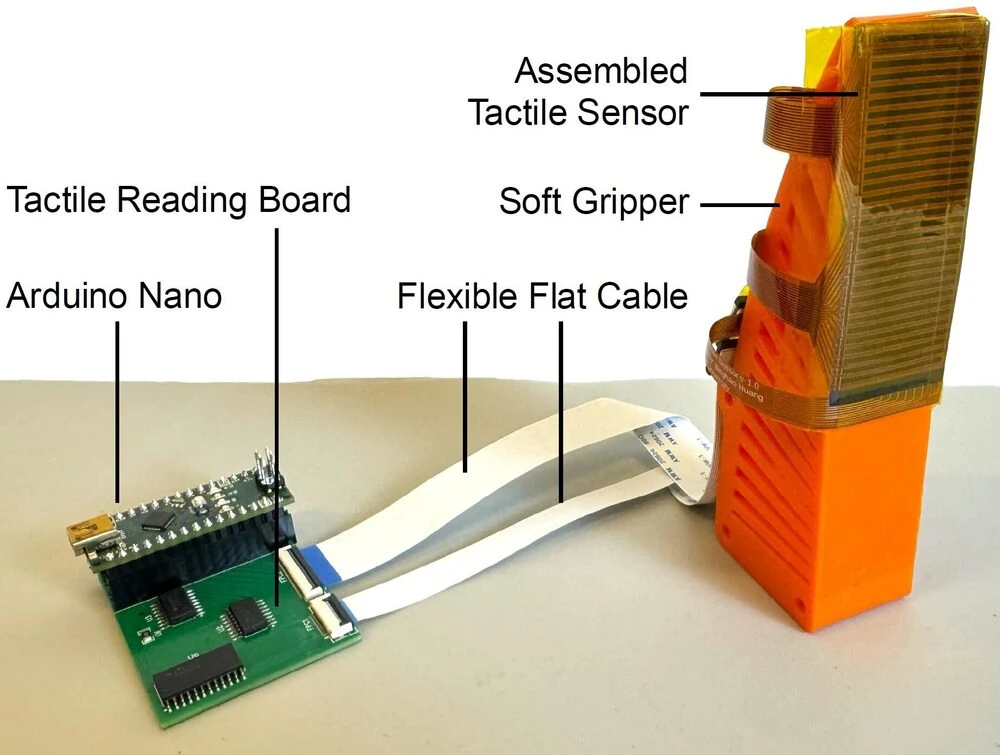
FlexiTac V2 moves both electrode patterns onto the flexible circuit board and seals a pressure-sensitive sheet between them: 32 × 12 points on a 2 mm grid, about US$2.50 a pad, three minutes to build, 100 Hz readout, all files open.
The interesting number in tactile sensing is not resolution. It is how much two nominally identical sensors disagree. Vision has a canonical sensor and a shared dataset; touch has neither, which is why a result from one lab is often unreproducible in another and why datasets harvested on different grippers cannot be pooled.
What changed in the second generation
FlexiTac, from Binghao Huang and Yunzhu Li at Columbia and presented in the demo track at CoRL 2026, is an open-source piezoresistive array built to attack that problem from the manufacturing end. The stack is deliberately ordinary: two flexible printed circuits carrying row and column electrodes, a pressure-sensitive conductive sheet (Velostat or Linqstat) between them, adhesive laminating film for structure and a polyimide border to seal the edges.
The first generation laid conductive threads by hand, which took about thirty minutes and made alignment a source of variance. V2 puts both electrode patterns into the FPC at manufacture and cuts the pressure-sensitive sheet and laminating film on a desktop cutting machine. Assembly drops to about three minutes, and the sources of part-to-part difference move from the assembler’s hands to the board house.
The numbers
- V2: 2 mm grid, 32 × 12 points, about US$2.50 per sensor pad, roughly three minutes to assemble
- V1: 3 mm grid, 16 × 16 points, about US$5 per pad, roughly thirty minutes
- resolution options include 8 × 16, 16 × 16, 32 × 12 and 32 × 32
- readout board with an Arduino Nano, multiplexers and shift registers, streaming at 100 Hz over 0.5 mm flexible flat cable
- complete unit including electronics around US$30
A 2 mm pitch works out to roughly 25 points per square centimetre — derived from the stated grid, not quoted in the source — which is one to two orders of magnitude below what research skins report for a fingertip and entirely adequate for a gripper-sized contact patch. The published bill of materials is worth reading alongside the headline price: US$2.50 buys the FPC pair, and total sensor materials land nearer US$4 once polyimide, laminating film and the pressure-sensitive sheet are counted.
Why open hardware is the actual contribution
The published bill of materials, Gerbers and assembly instructions do something a paper cannot: they let a second lab build the same sensor and compare numbers. The downstream record is the evidence that this works — the platform underpins 3D-ViTac (CoRL 2024) for fine-grained visuo-tactile manipulation, VT-Refine (CoRL 2025) for bimanual assembly, and a large-scale in-the-wild data collection effort at NeurIPS 2025. One hardware definition, several groups, comparable data.
There is a second, quieter benefit: because the stack is thin and its geometry is known, each taxel can be lifted into the camera’s 3D point cloud as a point carrying a pressure value. Tactile and vision then share one representation, which is what makes diffusion-policy training on contact tasks practical.
The honest limits
A pressure-sensitive conductive sheet is not a metrology device. The source documents geometry, cost and readout rate, and does not characterise drift, hysteresis, creep or temperature sensitivity — so the platform is excellent for learning research and unsuitable as a reference instrument. The piezoresistive sheet itself is a commodity film whose batch behaviour is not specified by the supplier in sensor terms. And a 2 mm pitch maps the shape of a contact patch; it does not resolve stress concentrations at the edge of a clamped joint.
What a film supplier should take from it
Three things. First, the reason dense tactile sensing stayed expensive was assembly, not material — moving the electrode pattern into the FPC removed most of the labour and most of the variance at the same time. Second, publishing the BOM is the cheapest reliability programme available: it turns “our sensor works” into “our sensor can be rebuilt and checked”. Third, and least comfortable, a US$2.50 pad sets a reference price for anyone selling a research-grade array, which raises the burden of proof on what the extra money buys — calibration, drift specification, and a stated interface.
Source: Huang, B. & Li, Y., “FlexiTac: A Low-Cost, Open-Source, Scalable Tactile Sensing Solution for Robotic Systems”, arXiv:2604.28156 (2026); hardware and BOM at flexitac.github.io.
我们做柔性压阻薄膜与 4096 点压力分布测量系统,正是为这类接触界面。