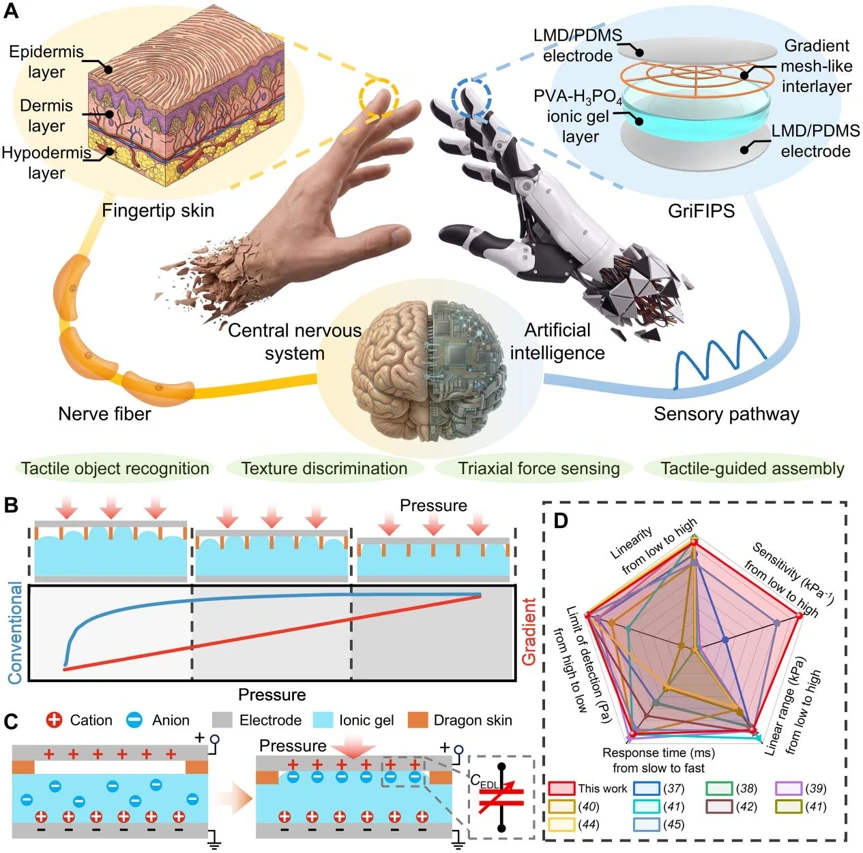
Instead of reformulating the ionic gel, a USTC-led team printed a 100 µm silicone mesh between gel and electrode. Contact starts at the centre hole and spreads outward as load rises, holding sensitivity at 175.9 kPa⁻¹ out to 360 kPa.
Iontronic pressure sensors get their sensitivity from the electric double layer that forms where an ionic gel meets an electrode. The same mechanism caps them: once the contact area saturates, the capacitance stops climbing and the sensor goes blind at higher loads. Most attempts to fix this modify the functional layer — microstructure the gel, stack elastomers of graded modulus — which works in a lab dish and is painful to scale to an array.
Put the geometry in a separate layer
A team led by the University of Science and Technology of China, with the University of New South Wales, Soochow University, the University of Wollongong and Northwestern Polytechnical University, took a different route in Science Advances: leave the gel and the electrode chemistry alone, and print a mesh between them.
The interlayer is direct-write printed from Dragon Skin 20 silicone — three concentric rings of 4, 8 and 12 mm diameter, 100 µm line width, 100 µm thick, with apertures that widen from the centre outward. Because the mesh has a higher modulus than the gel, the gel is confined by the ribs and can only bulge up through the holes to reach the electrode. Contact begins at the centre aperture; as load rises, the contact region walks outward ring by ring. Finite element simulation and optical observation both confirm the progression.
The second half of the mechanism is at the electrode. It is a gallium–indium liquid metal and PDMS composite, insulating as cast; ultrasonic sintering fuses the droplets into a conductive path and leaves a micrometre-scale rough surface. A smooth copper control saturates quickly; the rough liquid-metal electrode keeps changing capacitance across the range. Macro contact is set by the mesh geometry, micro contact by the electrode texture.
Reported performance
- sensitivity 175.9 kPa⁻¹, linear to roughly 360 kPa (fit to 358.2 kPa) at R² = 0.997
- detection limit about 2.1 Pa, roughly the weight of a ladybird; response 25 ms, recovery 50 ms
- 6,000 cycles at 150 kPa, and 2,000 stretch cycles at 50% amplitude with the 200 kPa response unchanged
- five independently made devices read consistently
- under a 100–300 kPa static preload it still resolves a fluctuation of about 40 Pa
That last figure is the one that matters for real parts. Many sensors are characterised with nothing on them; a clamped joint, a seated connector or a compressed gasket arrives with a large static preload already applied, and the question is whether the sensor can still see the small variation on top of it.
What it does on a hand
On a dexterous fingertip with a temporal-convolutional network reading the signal, the sensor classified 14 materials from 1,400 samples at 99.86%. A freshly built sensor, dropped in without retuning the model, held 97.5% — a useful proxy for part-to-part consistency, which is where laboratory tactile sensors usually fail.
Cutting the electrode into four quadrants and adding a silicone hemisphere produced a three-axis version: normal load raises all four channels, shear tilts the hemisphere and drives diagonal channels in opposite directions. With that, sweeping 12 real fabrics gave 99.72% texture classification against 76.81–83.19% for any single channel — the same argument that applies to any contact measurement: four channels carrying a spatial pattern beat one channel carrying a number.
The honest limits
The authors list them plainly. Only three discrete mesh parameter sets were compared, so there is no full-parameter optimisation. The mesh is planar; wrapping it onto a finger needs a process that does not exist yet. The three-axis prototype is wired, and large-area array routing is unsolved. The classifier was trained and tested on samples from the same source, so behaviour on unfamiliar objects is unverified. Nothing here is a statement about service life under repeated industrial contact.
Why the separation matters
The transferable idea is architectural, not material. Putting the contact-control structure in its own printed layer means the response curve becomes a print parameter: change the ring diameters or the aperture taper and you retune range and linearity without touching the gel or the electrode. That is the same division of labour a pressure film already uses — material sets the signal, geometry (dot pitch, spacer height, aperture) sets how that signal maps to load — and it is why a film datasheet is meaningless without the dot geometry attached.
Source: Science Advances (2026), a USTC-led study of a gradient-mesh interlayer for iontronic pressure sensing. doi:10.1126/sciadv.aej9537
我们做柔性压阻薄膜与 4096 点压力分布测量系统,正是为这类接触界面。