A resistance-graded graphene fabric sensor reaches 19.69 kPa⁻¹ in air and 37.90 kPa⁻¹ submerged over 0.1–200 kPa. The gain comes from water pressure closing the layers — which also means the zero moves with depth.
A sensor that becomes roughly twice as sensitive once it is submerged sounds like a free upgrade. Mechanically it is a preload, and that distinction decides whether the effect is useful or merely interesting.
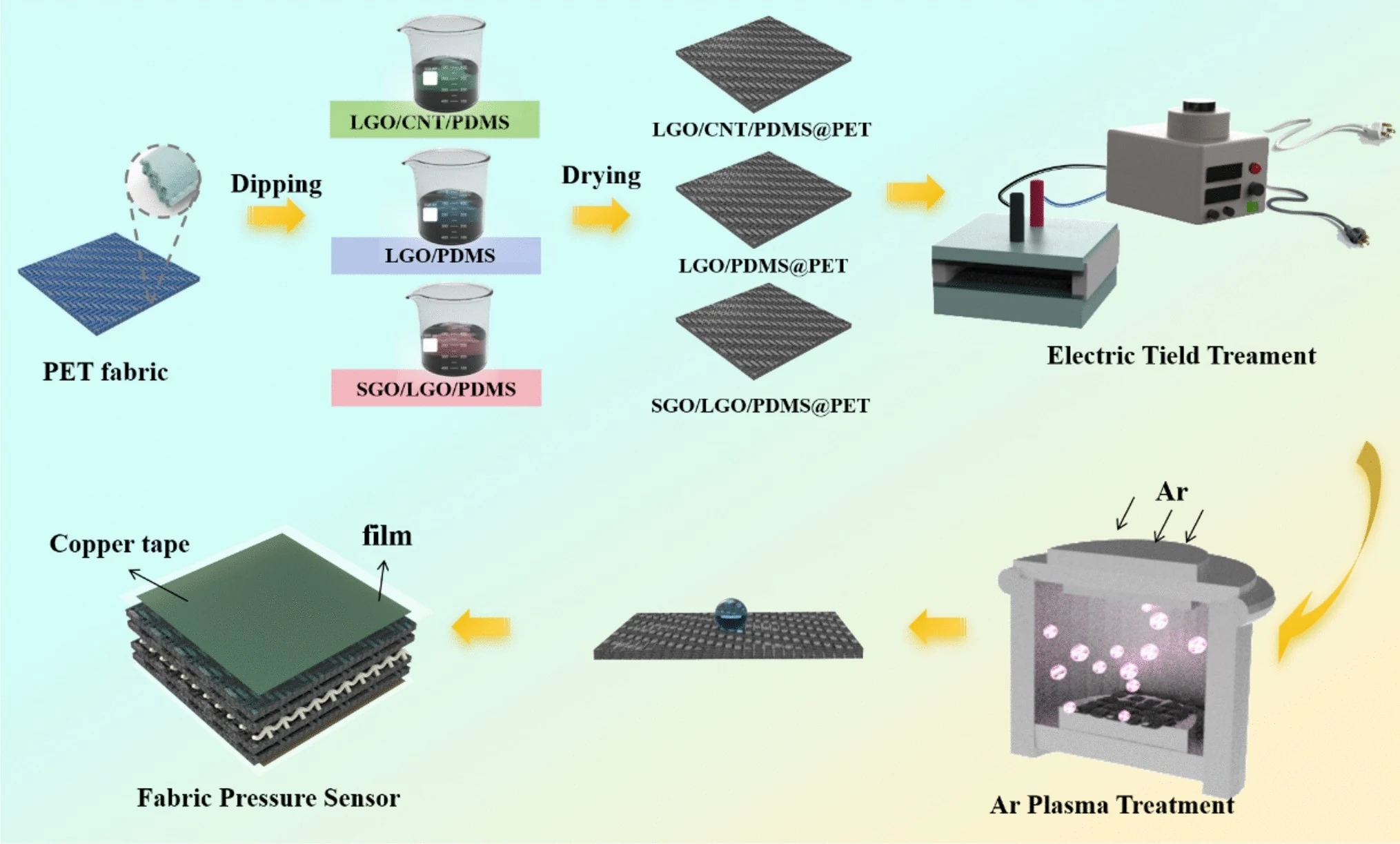
The device in question, reported in the Journal of Materials Science by Shi, Tao, Xu, Zhang and Guo, is a multilayer fabric stack: three polyester fabrics coated to different sheet resistances, separated by a medical gauze spacer, with copper tape electrodes and a superhydrophobic treatment over the whole assembly. The fabrics are made by dip coating in three formulations — graphene oxide with carbon nanotubes, graphene oxide alone, and a sulphur-doped variant — followed by electric-field alignment and argon plasma treatment.
What the numbers say
- quasi-linear response from 0.1 to 200 kPa
- in air: sensitivity 19.69 ± 0.94 kPa⁻¹, R² = 0.981
- underwater: sensitivity 37.90 ± 0.64 kPa⁻¹, R² = 0.998
- water sliding angle around 13°, i.e. the coating is superhydrophobic rather than merely water-resistant
Stacking order is a design variable, not a detail
The paper tests six ways of arranging the three fabric types and the result is not a rounding difference. Only one order keeps climbing to 200 kPa, reaching a current ratio near 7,600. Two others flatten out around 1,000 and 2,000, and the remaining three never get past a few hundred. Same materials, same coating, same spacer — the sequence alone moves the output at full scale by more than an order of magnitude.
The mechanism the authors give is progressive activation: as load rises, contact is established through successive layers rather than all at once, so the low-pressure regime is sensitive and the high-pressure regime does not saturate early. That is the same argument used for any graded or multi-layer stack, and the six-order result is the useful part of the paper for anyone building one — grading is not enough, the order of the grades is the design.
Why water raises the slope
Figure 4c is the panel worth looking at. In air the layers rest against each other loosely. Underwater, the surrounding water pressure pushes them together before any load is applied, so the stack starts from a tighter contact state and the same increment of load produces a larger change in current. The extra sensitivity is bought with a bias.
That has a direct consequence for marine use. If the baseline depends on how hard the water is pressing, then the zero point depends on depth: every ten metres of water adds roughly 0.1 MPa (derived), so at a hundred metres the water alone is loading the stack with more than the top of this sensor’s entire tested range. A beaker test at one atmosphere demonstrates the mechanism; it does not qualify the device for a hull, and a wet installation needs a preload compensation term that a dry calibration will never supply.
The honest limits
The published abstract reports no durability data, no response or recovery time, no temperature behaviour, no manufacturing reproducibility and no performance under movement — so the 0.1–200 kPa window and the two sensitivity figures are what is established, and the demonstrations are physiological signals and underwater motion tracking rather than structural monitoring. The 200 kPa ceiling also puts clamped and bolted interfaces outside its reach; those live at megapascal levels.
What a film supplier should take from it
Grading the sheet resistance of successive layers is one of the few ways to extend range without new chemistry, and it is compatible with ordinary coating equipment — which is why it keeps reappearing. The second lesson is less comfortable: any pressure sensor installed under water, under a clamp or inside a compressed stack is being preloaded by its environment, and a datasheet that quotes sensitivity without quoting preload sensitivity is describing a laboratory, not an installation.
Source: Shi, K., Tao, Y., Xu, X., Zhang, D. & Guo, Y., “A flexible piezoresistive sensor based on superhydrophobic graphene/polymer composite fabrics for highly sensitive and wide-range pressure detection in complex environments”, Journal of Materials Science 61(40), 31040–31055 (2026). doi:10.1007/s10853-026-13623-w
阅读原文: Journal of Materials Science ↗
我们做柔性压阻薄膜与 4096 点压力分布测量系统,正是为这类接触界面。