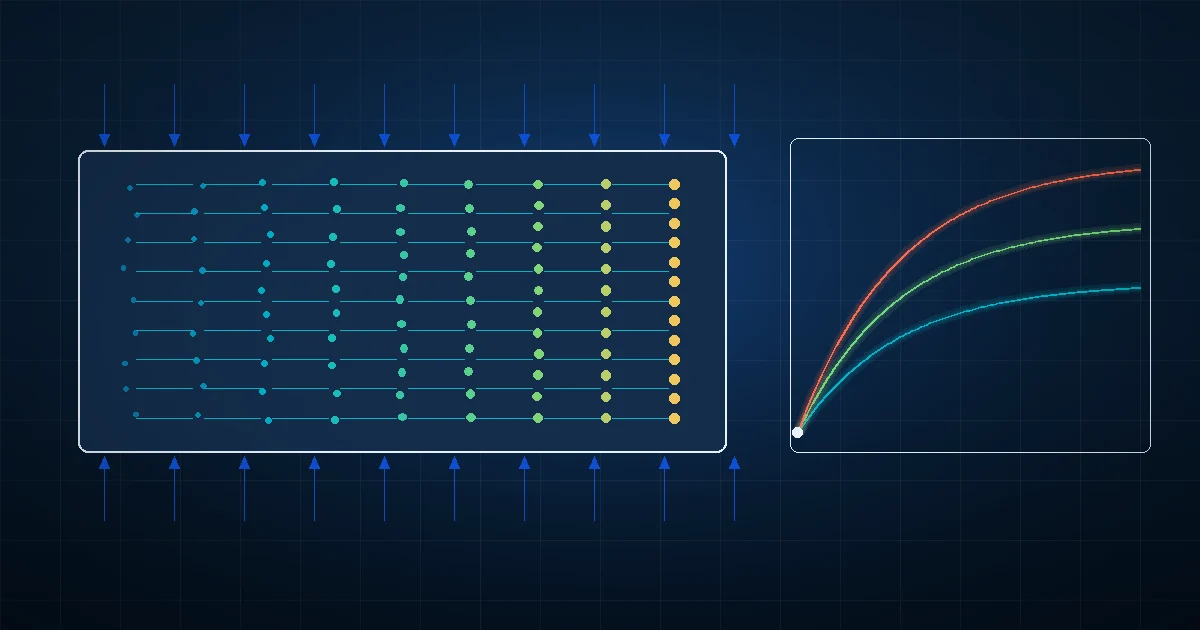
Instead of reformulating the compound for each pressure band, a piezoresistive skin re-forms its conductive network under an external magnetic field — one device covering six and a half decades, from a fingertip touch to a press.
Every piezoresistive compound carries a built-in compromise. Make it soft and compliant and it reads a fingertip, but the conductive paths close up and the output saturates before the load reaches a megapascal. Make it stiff enough for a press and the same sheet can no longer feel 1 Pa. The usual answer is a product family: three formulations, three ranges, three part numbers, and a customer who has to know their load before choosing a sensor.
A team working on bio-inspired tactile skin has taken a different route: leave the chemistry alone and change the conductive network itself, with a magnetic field applied from outside the device. The work is published in Nano Research (doi:10.26599/NR.2026.94908965).
What the device is made of
The sensing layer is built around two components that do different jobs. Neodymium-iron-boron particles, aligned into chains by a magnetic field during curing, act as conductive “islands”. Multi-walled carbon nanotubes grown on their surface act as “bridges” between those islands, and conduction across a bridge relies on electron tunnelling — which is exponentially sensitive to the gap it spans. Change how well the islands are chained, and the average gap changes, and the tunnelling current changes with it.
Two structural details do the rest of the work. A multi-level pyramid microstructure sits inside the layer, concentrating stress so that a light touch closes paths that would otherwise stay open; and a 5 nm hafnium oxide tunnelling barrier is grown at the interfaces to suppress the intrinsic noise of exactly that kind of interface. The authors report that the barrier lifts the signal-to-noise ratio by roughly a factor of 14.
The published numbers
- pressure range 1 Pa to 3.5 MPa
- low-pressure sensitivity 235.6 kPa⁻¹
- signal-to-noise ratio 89 dB in the mid-pressure region
- response time 10 ms
- more than 10,000 load cycles without reported degradation
- the same film, mounted on the sole of a commercial quadruped platform, used to classify five ground types while walking at 0.3 m/s
Six and a half decades, and why the bottom of the range is the hard part
One pascal is about 0.1 g spread over a square centimetre; 3.5 MPa is roughly 35 kg on the same area (both derived). Putting those on one device is the headline, and the mechanism explains how it is done: the magnetic field sets the initial chain order, so the same chemistry can be parked at the compliant end or the stiff end of its own transfer curve, and the pyramid structure keeps the transition gradual in between.
The more useful number, though, is not 235.6 kPa⁻¹. It is the barrier layer. A sensitivity figure says how fast the output moves; what decides whether 1 Pa can be read at all is the noise floor it moves against. If interface noise is equivalent to tens of pascals, a sensitivity of 235 kPa⁻¹ buys nothing at the bottom of the range — the signal is real, and invisible. Suppressing that noise is the unglamorous step that makes a wide-range claim meaningful, and the one most often left out of a datasheet.
The classifier is not the interesting part
The demonstration walks the robot over mud, sand, grass, rubber and tile at 0.3 m/s, at five different field strengths, collecting 5,000 samples, and trains a temporal network on the result. Peak accuracy is 99.21%, and the paper reports a pattern: soft ground is best sensed at low field, hard ground at high field.
That pattern is the point. A fixed-gain skin has to compromise its way through five surfaces; a skin whose operating point can be moved has, in effect, five sensors in one. The network is learning which setting suits which surface — a mapping a hand-tuned rule would largely reproduce.
The honest limits
The field has to come from somewhere. A coil or a permanent magnet has to be carried on the robot, and its mass, its current draw and its heat all land on the same limb that needs the sensing. The paper does not report demagnetisation over long service, nor how temperature affects the chain order — and a tactile skin on a robot that works outdoors will see both.
3.5 MPa is wide for a tactile skin and still two orders of magnitude short of a preloaded bolted flange, so this is not a replacement for a clamp-pressure film. The 10,000 cycles are laboratory cycles, not a service life. And 99.21% is closed-set accuracy over five surfaces; the open question is what happens on a surface nobody trained for.
What a film supplier should take from it
- Range is a design variable, not just a specification line. If sensitivity can be moved after the film is made, a product family collapses into one part number plus a setting.
- Write the noise floor into the datasheet next to the sensitivity. A sensitivity number without a noise number cannot be used to answer “what is the smallest load you can see”.
- An adjustable sensor needs a state-dependent calibration table. If the calibration was taken at one field value, records taken at another are not comparable — the same trap as any film installed with an unknown preload.
Source: Nano Research (2026), “bio-inspired adaptive electronic skin based on an island–bridge topological conductive network”, doi:10.26599/NR.2026.94908965. All device figures are as reported by the authors; no independent replication is cited.
我们做柔性压阻薄膜与 4096 点压力分布测量系统,正是为这类接触界面。