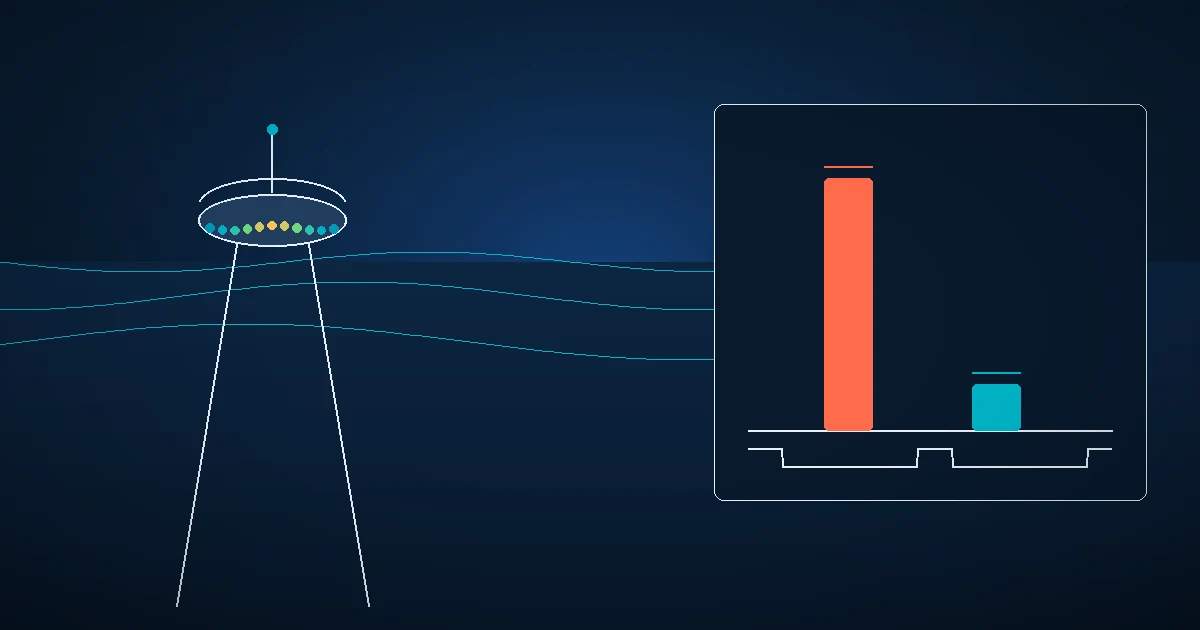
A triboelectric generator has gone from 120 W/m³ peak at sea to kilowatt peaks in a one-cubic-metre unit. The number that matters for a sensor buoy is the average, and it decides the sample rate before the sensor does.
Put a pressure array on a floating platform and the first engineering question is not range, resolution or IP rating. It is where the electricity comes from. A cable to shore is a project; a battery is a maintenance visit; and a solar panel on a buoy in the North Sea in December is a rounding error.
That is why wave energy keeps reappearing in marine sensing conversations, and why a progress report published on 2 November is worth reading even though it is about generation rather than measurement. The technology in question is the triboelectric nanogenerator: two materials are brought into contact and separated, the surface charge they exchange drives a current through an external circuit, and the output is largest for the low-frequency, irregular motion that waves happen to provide.
The numbers from the water
- first sea trial, from 2023: peak power density 120 W per cubic metre, average 22 W per cubic metre
- 2025: a one-cubic-metre single unit went into test
- 2026: peak power reported at kilowatt level
- next step: networked generation, with a kilowatt-class demonstration as the stated target
- the team’s own timeline: five to ten years to treat ocean energy as a large-scale source alongside wind and solar
The same report points at the application that matters here — self-powered marine monitoring, distributed smart buoys, and what the authors call an ocean internet of things, spanning everything from aquaculture to subsea pipeline surveillance.
Peak, average, and the gap between them
The five-to-one gap between peak and average is the whole design problem in one line. Averages are what a battery is sized against; peaks are what a converter has to survive. Twenty-two watts per cubic metre of average output is a real budget for a modest data logger, and it is nowhere near enough for continuous high-rate acquisition with a radio attached.
Do the arithmetic on a large array and the pressure to reduce duty cycle becomes obvious. A 4,096-point map sampled at 20 Hz produces just over 80,000 samples per second; at 12 bits that is roughly 123 kB/s before any overhead (derived). Transmitting that continuously is a satellite budget, not a buoy budget. So the realistic architecture is local storage with periodic upload, or an event-triggered mode that keeps the full rate only while a threshold is crossed.
There is also an electrical mismatch that the power-density figures hide. Triboelectric output is high-voltage, low-current and high-impedance, while the logic behind a sensor array wants a regulated low voltage. Rectification, impedance matching and a buffer capacitor are not accessories; they are where a large share of the harvested energy is lost if they are chosen badly. A peak figure measured into an optimised load is not the same as a peak figure available at 5 V.
Why this belongs in a pressure-mapping conversation
Because the sensor and the harvester are the same kind of object. Both are thin-film, both are laminated or printed, both are being asked to survive salt water for years, and both fail at the interfaces rather than in the bulk. A supplier that can laminate a 0.3 mm sensing film can laminate a generator; the packaging, the lead-out and the encapsulation problem are shared.
It also resets the specification conversation. A pressure array sold for a test bench is characterised at 20 Hz because 20 Hz is comfortable; a pressure array sold for a buoy is characterised at whatever the energy budget allows, and that number may be 0.2 Hz. Which is fine — blade and hull loads are slow — as long as nobody quotes the bench figure on the marine drawing.
The honest limits
This is a generation report, not a metrology result. The figures are the team’s own, from sea trials whose duration, sea state and measurement method are not given in the source, and the report does not distinguish electrical output from mechanical input when quoting power density — a distinction that changes the useful number by the conversion efficiency.
Nothing in the report addresses biofouling, which is the failure mode that ends most marine deployments: a few millimetres of growth changes both the hydrodynamics of a buoy and the behaviour of a contact-separated generator. Corrosion of the electrode and long-term drift of the surface charge are likewise not discussed. And the energy is only there when there are waves; a flat calm is a battery problem, not a harvesting problem.
What to ask before putting an array at sea
- average harvested power over a full year at the deployment site, not peak power density at a good moment
- conversion efficiency into the voltage the logger actually needs
- the duty cycle the energy budget supports, and what the array does when it is not sampling
- how the film is bonded and sealed, and what happens when the bond fails — a de-bonded film on a buoy is a piece of litter
Source: People’s Daily science report on triboelectric wave energy, 2 November 2026, republished by the Beijing Municipal Science and Technology Commission. Performance figures are as stated by the research team.
我们做柔性压阻薄膜与 4096 点压力分布测量系统,正是为这类接触界面。