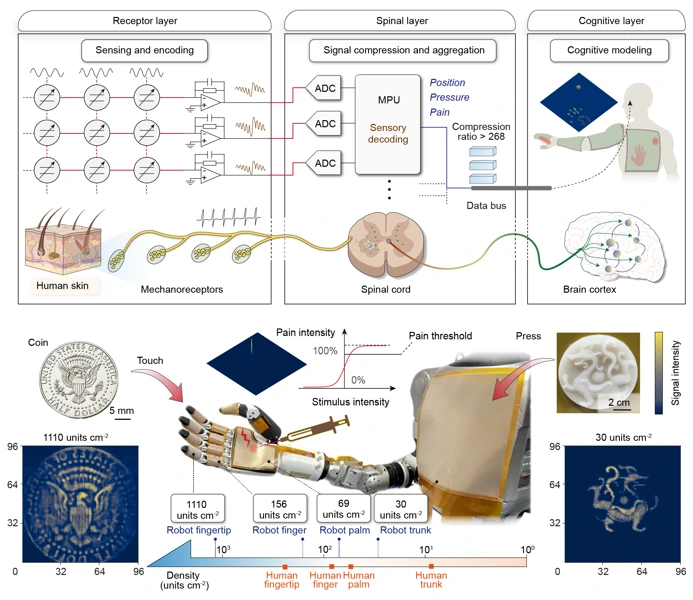
A 96 × 96 iontronic skin from a Southern University of Science and Technology team carries 1,110 sensing units per square centimetre and reads the whole array at 100 frames per second — by assigning each unit its own frequency instead of scanning points in turn.
A robot can lift a crate and still crush a 0.2 mm solder wire. The limit is rarely strength; it is that the gripper has no idea how much pressure it is applying where. A paper published on 16 October 2026 in Nature Machine Intelligence attacks both halves of that problem at once: a skin dense enough to feel a wire, and a readout architecture that survives having that many sensors.
What was built
The team, led by Guo Chuanfei at the Southern University of Science and Technology with collaborators including the Beijing Institute of Technology, reports an iontronic skin with 1,110 sensing units per square centimetre. A single block is a 96 × 96 array; more than 10,000 units were integrated and deployed across a robotic hand, forearm and torso.
The sensing structure is an ionic gel sandwiched between coplanar cross electrodes. Pressure deforms the gel, ions redistribute, and the capacitance change is read as signal. Because the whole stack is soft, it conforms to curved surfaces — which is the point of putting it on a limb rather than a fingertip pad.
The bottleneck was never the sensor
Dense arrays fail at the wiring, not at the material. Conventional matrix arrays interrogate pixels one after another: as the count climbs, frame rate falls, crosstalk between neighbours grows, and the volume of raw data becomes impossible to move off the skin. Past a few thousand points, the readout becomes the design constraint.
The reported architecture borrows its structure from the tactile nervous system and works in three stages:
- Frequency-parallel encoding. Each sensing unit transmits at its own characteristic frequency — the paper illustrates the scheme with values around 4.0, 4.2 and 4.4 kHz. The frequency identifies the channel, the amplitude carries the force, so many units share one line at the same time.
- Local convergence and compression. Signals are merged and compressed at the skin before being forwarded to the robot controller. The reported compression is 268-fold, which is what makes a 10,000-unit skin practical rather than a bandwidth problem.
- Interpretation. The compressed stream feeds a machine-learning model that classifies contact rather than shipping raw measurements upstream.
The result reads a full frame at up to 100 frames per second. In demonstration the skin allowed a gripper to handle a 0.5 mm pencil lead and a 0.2 mm solder wire, resolved surface texture down to 300 µm, and recognised concentrated pressure of the kind that precedes damage — enough to trigger a withdrawal response.
What it changes for pressure mapping
Two things, and they are worth separating. First, this is evidence that the readout, not the sensing layer, is where dense arrays break: adding points is easy, reading them is not. Anyone specifying a high-channel-count array should ask how the channels are addressed before asking about sensitivity. Second, the intended use is different from industrial surface pressure measurement. A skin at 1,110 units/cm² is solving for texture and slip during manipulation on a surface of a few square centimetres. A film measuring clamping pressure across a 500 mm blade section typically spaces points several millimetres apart and cares about absolute value, repeatability after a thousand load cycles, and whether the reading survives being pressed against a contaminated surface. Density helps neither requirement on its own.
What is not established
The demonstrations are laboratory work. Durability under repeated contact, manufacturability at volume, cost per unit area and behaviour in an industrial environment are not reported. The paper also does not claim human-level touch or general-purpose manipulation. The research was supported by National Natural Science Foundation of China grants T2225017 and 62103180.
Source: National Natural Science Foundation of China; the paper is “Large-scale iontronic skins with neural-hierarchical processing architecture”, Nature Machine Intelligence, 16 October 2026.
我们做柔性压阻薄膜与 4096 点压力分布测量系统,正是为这类接触界面。