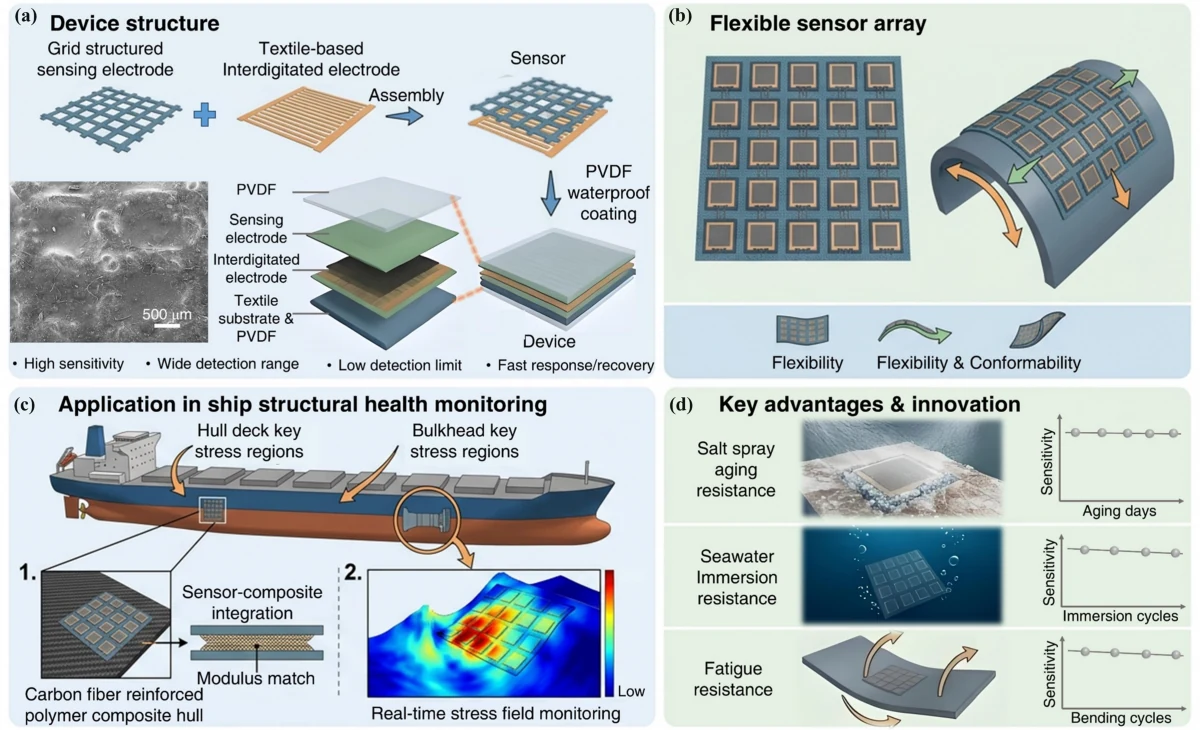
A 5 × 5 textile piezoresistive array has reconstructed stress distribution across ship hull panels, matching finite element results at R² = 0.96 and holding more than 95% of its sensitivity through 15 days of salt spray.
Hull monitoring has a coverage problem disguised as a sensor problem. Strain gauges and fibre Bragg gratings are discrete instruments: put a hundred on a ship and there are still metres of plate between them that nobody is watching. Slamming loads — the ones that matter for fatigue — are exactly the localised events that fall in those gaps.
An array instead of points
A study published in the Journal of Materials Science reports a textile-based piezoresistive array built to cover area rather than points. The 5 × 5 array uses grid-structured sensing electrodes modified in sequence with MXene nanosheets and PEDOT:PSS; screen-printed silver interdigitated electrodes handle readout, and thin PVDF encapsulation keeps water off the active structure without making the patch stiff. Row–column addressing interrogates the 25 pixels and suppresses crosstalk between neighbours.
Reported performance at pixel level:
- sensitivity of 1,143.5 kPa⁻¹, with response and recovery times of 10 ms
- detection limit down to 1 Pa
- reconstructed stress distribution matching finite element simulation at R² = 0.96
- more than 95% of initial sensitivity retained after 15 days of salt-spray ageing, with baseline drift below 3% during dynamic seawater cycling
Two load regimes on one patch
Mounted on typical stress-concentrated areas of a hull, the array captured both low-amplitude wave-induced cyclic stress and high-amplitude slamming transients. That combination is the practical argument for area sensing: the same instrument that tracks a slow fatigue signal also catches the event that starts a crack, and it shows where on the panel either one happened.
The honest limits
Twenty-five pixels is a coarse grid. It shows the shape of a stress field; it will not resolve a local peak inside one, and no physical array dimensions are given that would let a reader convert pixel count into millimetres on a plate. The demonstration is on selected stress-concentrated regions, not a vessel-wide deployment, and the R² of 0.96 is agreement with a finite element model rather than with an independent measurement of the true stress. Marine durability is reported over 15 days of salt spray — a meaningful screening result, and short of a service life measured in decades.
Why it matters beyond ships
The engineering problem here is the same one that shows up on any large curved surface: keep a thin sensor compliant enough to conform, seal it against the medium, address enough pixels to see a shape rather than a number, and keep the baseline from wandering. A hull in seawater is the hard version of all four. Any of them failing produces a map that looks plausible and is wrong — and unlike a single-point reading, a wrong map is hard to spot by eye.
Source: Xie, Y. & Zhang, Q., “Large-area textile-based piezoresistive sensor array for hull stress distribution mapping”, Journal of Materials Science 61(40), 30976–30991 (2026). doi:10.1007/s10853-026-13667-y
阅读原文: Journal of Materials Science ↗
我们做柔性压阻薄膜与 4096 点压力分布测量系统,正是为这类接触界面。