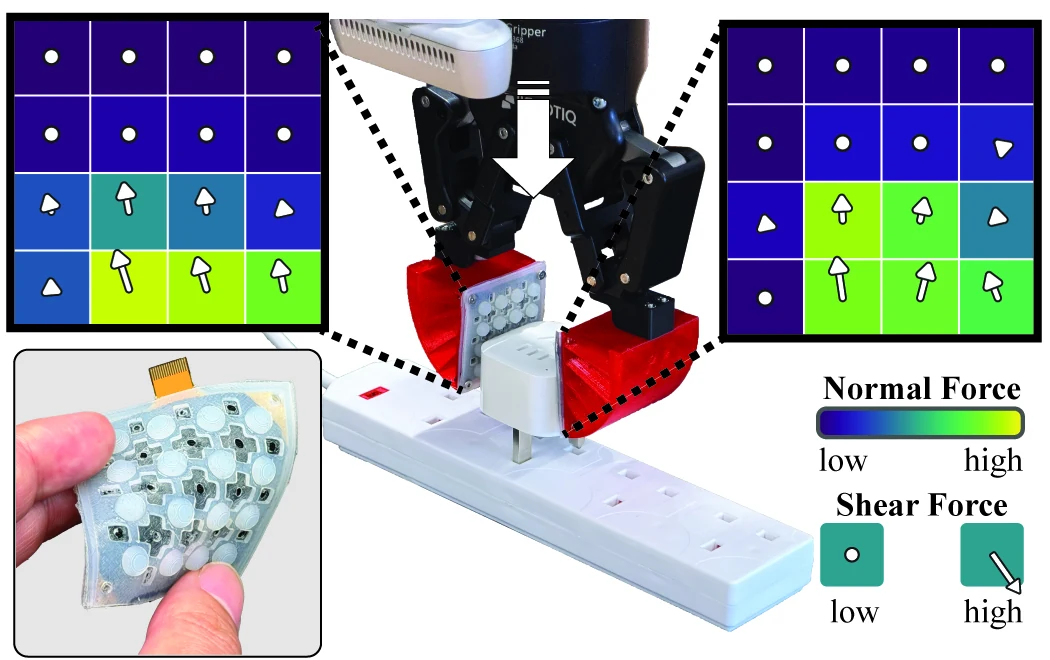
VecTile puts a piezoresistive layer under an array of passive silicone nubs. Normal and shear force deform the pattern differently, so a 4 × 4 array costing under $35 reads three axes without any three-axis sensing element.
Most flexible tactile arrays measure normal force and nothing else. Shear is what tells a gripper that an object is sliding, that a connector is misaligned, or that a blade is being fed in at an angle — and shear is precisely what a pressure-sensitive film cannot read directly, because its pixels respond to the component pushing into them.
Let the geometry do the work
VecTile, posted to arXiv on 22 October 2026 by Jian Hou, Xin Zhou and Adam J. Spiers, takes an indirect route. A piezoresistive layer sits underneath a moulded array of passive silicone nubs. A normal load presses the nubs down evenly; a shear load tilts them and shifts where the load lands. Either way the sensor records a pressure pattern — and the two patterns are different. Three-axis force falls out of a single-axis sensing layer plus a known geometry.
Reported numbers for the 4 × 4 build:
- 6 mm total thickness, assembled in-house without specialised equipment
- complete system under $35 for a 4 × 4 array
- tested over 1–5 N normal force and up to 1.5 N shear
- root-mean-square error of 0.39 N for normal and 0.16 N for shear
- a unit calibrated flat retains accuracy when curved; a five-minute manual calibration is enough for practical use
Two demonstrations are more telling than the error figures. Shear readings were sensitive enough to stop a scalpel from puncturing a balloon the moment it touched. Feeding the sensor into a Diffusion Policy controller substantially improved power-plug insertion — a task where the failure mode is not “not enough force” but “force applied at the wrong angle”.
The argument for mapping, made by a tactile sensor
This is the clearest recent illustration of why distribution beats a point reading. A single force sensor at the wrist knows the total; it cannot distinguish a well-seated contact from an edge-loaded one producing the same total. A pressure pattern can, because the shape carries the information. It is the same reason a bolted joint or a clamped blade root needs a map: the number that matters is not the sum, it is where the sum sits.
Where this does not transfer
Six millimetres is thick. For an interface being closed to a controlled gap — a cold plate on a chip package, a bonded repair patch, a clamped laminate — a 6 mm pad changes the thing it is measuring, and films in that role are an order of magnitude thinner. A 4 × 4 grid is also coarse, and the calibration is manual. The work is a preprint submitted to ICRA 2027 and has not completed peer review; the cost figure is a bill of materials for an in-house build, not a production price.
Source: Hou, J., Zhou, X. & Spiers, A. J., “VecTile: A Low-Cost Flexible Tactile Array for 3-DoF Force Sensing”, arXiv:2610.31472 [cs.RO], 22 October 2026.
我们做柔性压阻薄膜与 4096 点压力分布测量系统,正是为这类接触界面。