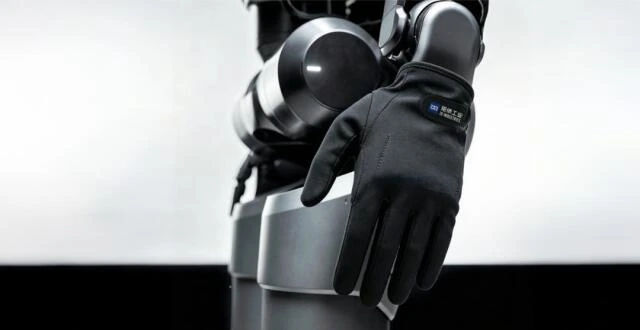
Juqiao Industries raised a RMB 100 million A round led by Ant Group for a tactile skin that takes the laminate apart: piezoresistive compound and electrode become separate fibres, and the weave itself is the sensor.
A laminated pressure sensor is three films glued into one: substrate, sensing layer, electrode. Each interface between them is a place where the stack can slide, fatigue or peel, and each one adds thickness. The alternative is to stop making a stack and start making a yarn.
That is the route Juqiao Industries has taken, and on 29 October the Weihai company closed a RMB 100 million A round led by Ant Group, with existing investors Lingyi Venture Capital, Weihai Gangrong and Qingdao Hexin following. The money is earmarked for volume production and delivery of the fabric skin, for tactile and multimodal sensing development, and for expansion into robotics, smart home and elder care.
Taking the sandwich apart
In a conventional film the substrate, the conductive layer and the pressure-sensitive layer are three materials laminated in sequence. Juqiao’s version splits those functions into separate fibres — a nylon core carrying the piezoresistive compound, and a separate electrode fibre — and then weaves them into a network. Contact deforms the weave locally, the conductive paths between fibres change, and the readout electronics turn that into calibrated tactile data.
The consequence is structural rather than chemical. The sensor is no longer a layer applied to a surface; the fabric is the sensor. There is no adhesive interface between a sensing film and a substrate, because there is no substrate. The company’s own comparison table makes the trade explicit: a laminated film is stable and precise but does not breathe, does not survive a sharp fold and does not tolerate washing, while a woven network does all three and gives up single-point precision.
The numbers the company publishes
- tactile glove: several hundred sensing points per hand, minimum element pitch 2 mm, minimum trigger force 0.01 N
- skin generation 2: under 0.8 mm for the multilayer stack, under 0.3 mm for the thinnest single-layer product
- the second generation adds force direction, slip tendency and tangential force by changing the weave structure and training a model on the result
- in-house line in Weihai covering formulation, fibre spinning, dyeing and finishing and weaving, with yield above 95% and sampling inside 24 hours
- more than 400 customers, of which over 200 are in embodied AI; close to 10,000 gloves delivered
The company also reports a Class II medical device registration for its care line and deployments in smart wards, mattresses and vehicle seating — which matters less for the robotics story than for the production line, because those orders keep the looms loaded while humanoid demand is still lumpy.
Why the manufacturing route is the actual news
A woven sensor scales with loom width and line speed, not with sheet size. That is a different cost curve from lamination, where throughput is set by presses and the yield limit is usually the adhesive bond. It also means the design iteration loop is a textile one: change the weave, re-sample in a day, test. The RMB 100 million is being spent on exactly that, and on the yield figure that decides whether a fabric skin can be sold by the square metre.
The honest limits
All of the numbers above are company disclosures; no third-party cycling, drift or wash-durability data has been published alongside them. Single-point accuracy is acknowledged by the company itself to trail both laminated films and vision-based tactile sensors, which is why it positions the fabric for palms, forearms, torsos and soles rather than fingertips. A 2 mm pitch maps the shape of a contact patch; it does not resolve the stress concentration at the edge of a clamped joint, and it is not a metrology instrument.
What a film supplier should take from it
Three things. First, interface count belongs in a reliability specification: every adhesive layer in a laminate is a fatigue site, and the fabric route removes two of them by construction. Second, the market split the company describes — high precision at the fingertip, large breathable area everywhere else — is probably correct, and it implies hybrid assemblies rather than one sensor technology winning. Third, and least comfortable for anyone selling film by the sheet, a woven sensor is priced by area, and area is where textiles have a century of cost reduction behind them.
Source: Robot Frontline, “Ant Group leads RMB 100 million Series A in Juqiao Industries”, 29 October 2026; technical and commercial figures are as disclosed by the company.
我们做柔性压阻薄膜与 4096 点压力分布测量系统,正是为这类接触界面。