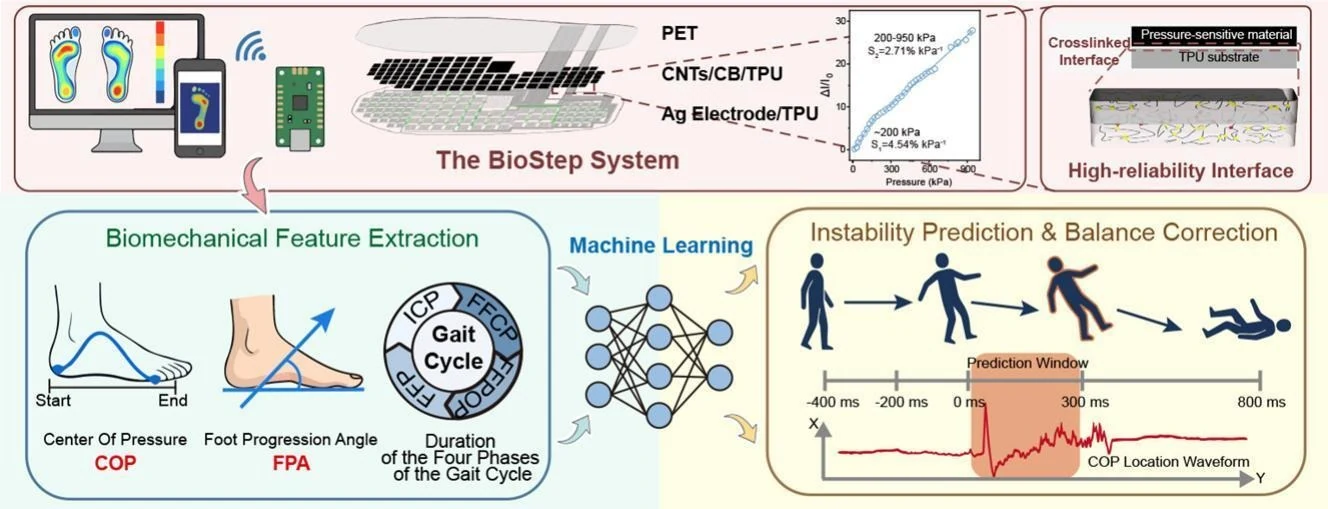
BioStep maps plantar pressure to 950 kPa with an anatomically distributed 105-channel array, but the paper’s real subject is the bond: a solvent-induced interface at 316 J/m² that stops the laminate delaminating under gait loading.
An insole is the least forgiving place to put a pressure array. It is loaded every step, it bends at the metatarsal line, it gets damp, and it has to stay calibrated for months while a person walks on it. The published failure mode for insoles is rarely the sensing material; it is the laminate coming apart.
What was built
BioStep, from a Beihang University group in the School of Materials Science and Engineering with the School of Computer Science, published in the Chemical Engineering Journal on 15 October 2026, is a 105-channel flexible piezoresistive array distributed according to the anatomy of plantar loading rather than on a uniform grid. The array sits under a wireless multichannel readout.
The stated numbers: a sensing range to 950 kPa, more than 5,000 cycles, a signal-to-noise ratio of 38.07 dB with what the authors describe as negligible crosstalk, and interfacial toughness of 316 J/m² achieved by a solvent-induced polymer chain diffusion strategy. The graphical abstract shows the response is deliberately dual-slope — about 4.54 kPa⁻¹ below 200 kPa and 2.71 kPa⁻¹ from 200 to 950 kPa.
Why the interface is the headline
Interfacial toughness is not a number that normally appears in a sensor datasheet, and it should. 316 J/m² is a measure of how much energy the bond between the pressure-sensitive layer and its substrate absorbs before it propagates a crack. In a laminate that flexes thousands of times, the crack starts at an edge or at a stiffness discontinuity and then runs. Once it runs, the layer is still sensing — it is just sensing a gap.
This is the failure that never appears in a bench characterisation. A film clamped on a platen for 5,000 cycles at constant load looks excellent; the same film on a part that bends 20° twice a second delaminates, and the resulting map drifts in a pattern that looks like a real pressure gradient. Anyone specifying a film array for a curved, cyclically loaded interface should be asking for this number, not just sensitivity.
From map to prediction
The analysis extracts centre-of-pressure trajectories, foot progression angle and regional loading dynamics from the map, then classifies with machine learning. The claim that will get quoted is 98.98% accuracy in predicting fall direction before the fall, with the response visible in a window that the graphical abstract places between roughly 400 ms before and 800 ms after the perturbation.
The mechanics behind that number are worth stating: the input is not a force reading but the spatiotemporal evolution of a pressure distribution — where the centre of pressure is moving and how fast, which is exactly the information a single load cell cannot provide and a map can.
The honest limits
5,000 cycles is a screening number, not a footwear lifetime; a shoe sees that in weeks of daily walking. 105 channels across a foot is coarse — useful for regions and trajectories, not for resolving a peak inside a metatarsal head. The fall-prediction accuracy is measured on the study’s own protocol and subject set, which is a long way from a prospective clinical trial. Delamination resistance is reported as a material property; whether the same toughness holds after solvent exposure, sweat and temperature cycling is a separate question the paper does not answer here.
The transferable lesson
A pressure map is only as good as its bond line. For anyone deploying film sensors on a clamped or bonded interface — a cold plate, a gasket, a laminate under a repair patch — the useful sequence is: cycle the actual assembly, not a platen; check the baseline at zero load between runs, because a delaminated sensor reads a plausible field; and treat interfacial toughness as a specification, since it predicts whether the calibration you did on day one still applies on day ninety.
Source: Yin, C., Zhu, W., Li, Y., Huang, Y., Hu, S., Zhang, G. & Deng, Y., “A biomechanics-guided flexible pressure insole for high-fidelity spatiotemporal gait tracking and proactive fall prediction”, Chemical Engineering Journal 546, 180475 (2026). doi:10.1016/j.cej.2026.180475
Read the full story at Chemical Engineering Journal ↗
We build flexible piezoresistive films and 4096-point mapping systems for interfaces like this one.