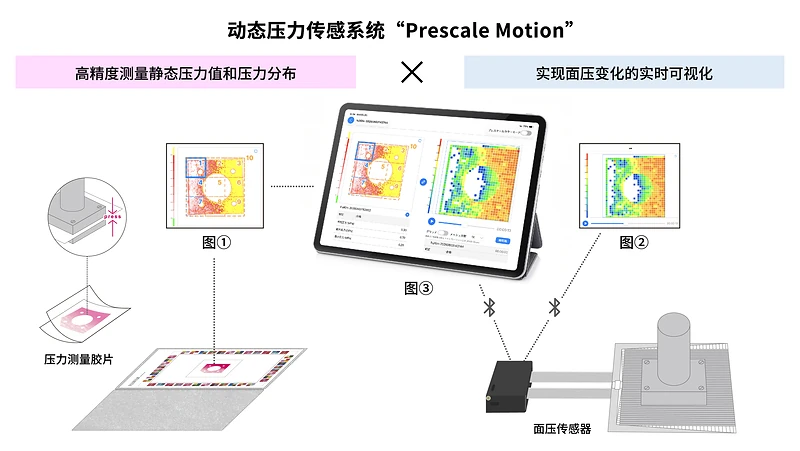
Prescale Motion pairs a 0.2 mm pressure film with a 32 × 32 controller and a Bluetooth link to an iOS app, so the same session yields both the peak-pressure sheet and the load history.
A pressure-sensitive film has always answered two questions and refused a third. Where the load sat, and how hard — yes, once the sheet is peeled off and the colour is read. When it happened — no. The sheet integrates everything it sees into a single final image, so a five-second spike and a five-minute creep leave the same mark.
Fujifilm’s Prescale Motion, on sale since 7 September and announced through PR Newswire on 29 October, is an attempt to answer the third question without giving up the film. The kit is a dedicated film carrying a printed sensor array, a small controller that clips to it, and an iOS app that receives the data over Bluetooth LE. The developed sheet and the live array are then recorded and analysed in the same session.
Two channels that are not redundant
The static half is the existing workflow: a Prescale sheet develops red under load, and the Prescale Mobile app photographs it against a calibration card and returns thirteen quantities — maximum, minimum and mean pressure, loaded area and the like. The dynamic half is new: the array reports pressure against time for the whole press, at whatever rate the controller manages, and the app overlays the two so the peak map and the load history sit on one screen. The film is detachable, so a controller can outlive many sheets, and each sheet ships with its own calibration file that is loaded onto the phone before measurement.
The published specification
- film thickness under 0.2 mm
- two formats: 80 mm square with 2.5 mm elements, and 200 mm square with 6.25 mm elements
- controller: 1,024 measurement points arranged 32 × 32, 8-bit conversion, about 30 Hz, Bluetooth LE, internal battery
- recommended pressure band 0.5–2.5 MPa, movable through a sensitivity setting
What those numbers do to a measurement
The channel count is fixed, so the two formats trade area against density: 32 × 32 over 80 mm works out to about 16 points per square centimetre, and the same 1,024 points spread over 200 mm gives about 2.6 — the larger sheet covers 6.25 times the area at a sixth of the density (both derived from the stated geometry, not quoted by the manufacturer). Choosing a format is therefore choosing what spatial detail to give up.
At 30 Hz a frame arrives every 33 ms. Anything faster than that is not resolved: a short event is either missed between frames or, if it repeats, aliased into a slow beat that looks like a real trend. For a polish head the rotation period is the relevant yardstick, and for a cell breathing over a charge cycle 30 Hz is comfortably fast.
Eight bits over the recommended band gives 256 levels; if the converter spans 0.5–2.5 MPa linearly, one count is about 7.8 kPa (derived, and the real transfer function is not linear). That is adequate for finding a hot spot and coarse for resolving the edge of one.
Why the two named applications are the two named applications
The release points at wafer polishing and at lithium-ion cells, and the pairing is not arbitrary. Chemical-mechanical polishing is governed by the contact state between head and wafer during the polish, which is exactly the quantity that a static sheet cannot see — the sheet tells you what the contact looked like after the fact, not whether it drifted mid-process. Cell stack pressure is the opposite case: pouch cells swell and contract with every cycle, the signal is slow, and a 30 Hz array is more than enough to record it. One application needs the clock, the other mainly needs a permanent installation.
The honest limits
Inserting a film changes the interface it is measuring. A 0.2 mm sheet in a polishing head stack is a compliant layer inside a gap measured in tens of microns, so the pressure reported is the pressure with the film present — the same insertion effect that applies to any film, ours included, and the reason a film measurement should always be reported together with what was inserted and where.
The recommended band starts at 0.5 MPa. Below that the sheet is outside its intended window, and although the sensitivity setting can move the band, the 8-bit converter does not get finer. The release also does not quote the film’s own mechanical time constant, hysteresis or creep under a long static press, so 30 Hz describes the electronics rather than the sensor. Per-sheet calibration files are the right instinct; the question worth asking is whether the file is bound to a sheet serial number, because that is what makes a dynamic record traceable a year later.
What to ask any film supplier, including us
- frame rate and converter depth, stated separately from the film’s response time
- whether calibration is per sheet, per batch or per production run
- film thickness against the gap being measured, and the insertion effect that follows
- behaviour below the recommended pressure band
- what the signal does after ten minutes under constant load — creep is the failure mode that static sheets hide
Source: Fujifilm, “FUJIFILM Prescale Motion” launch release, PR Newswire, 29 October 2026. Product specifications as published by the manufacturer; no independent test data is cited.
Read the full story at Fujifilm ↗
We build flexible piezoresistive films and 4096-point mapping systems for interfaces like this one.