What 4,096 sensing points actually resolve on a 490 × 520 mm sheet
A 490 × 520 mm sheet carries 4,096 points at a 7.6 × 8.1 mm pitch. The total is what gets quoted; the pitch is what decides whether you see a shape or just a number.
PDRELTEST engineering · 2 min read · 2026-10-26
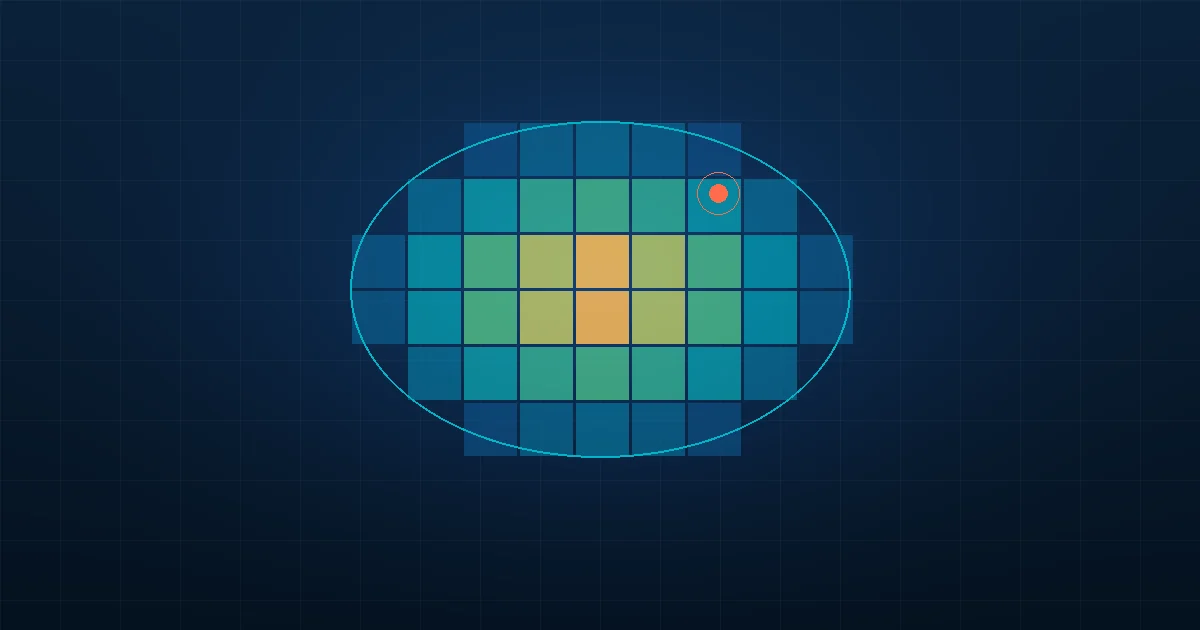
A pressure sensing sheet with 4,096 points on 490 × 520 mm is usually quoted as one number and compared with other numbers. The figure that decides what it can see is not the total. It is the pitch: 7.6 × 8.1 mm between adjacent points on the standard film build.
What the pitch resolves
A contact feature three points wide or more comes out with a shape. Six points across a 50 mm saddle edge shows you where the peak sits and which way it leans. A feature narrower than one pitch is averaged into its neighbours — an 8 mm inclusion under a bond line appears as a slightly higher reading, not as an inclusion.
What it cannot see
Between points there is interpolation, and the sensing layer averages over its own contact area. So 4,096 points proves the absence of peaks wider than about 8 mm. It does not prove the absence of sharp ones. More density means a custom array: smaller pitch, more points, more channels, longer acquisition.
The question worth asking first
Measure the smallest feature you need to see, then divide by the pitch. Three or more, and you are mapping a shape. One, and you are detecting an event. Both are legitimate measurements. Only one of them lets you say where the edge is — and if the answer says you need a different range or encapsulation, that choice comes first.