Piezoresistive or capacitive: two ways a pressure film can work
Both are thin, both produce a pressure map. They differ in what they are good at — and in how they fail. Asking which principle a supplier uses tells you more than an accuracy figure.
PDRELTEST engineering · 2 min read · 2026-10-26
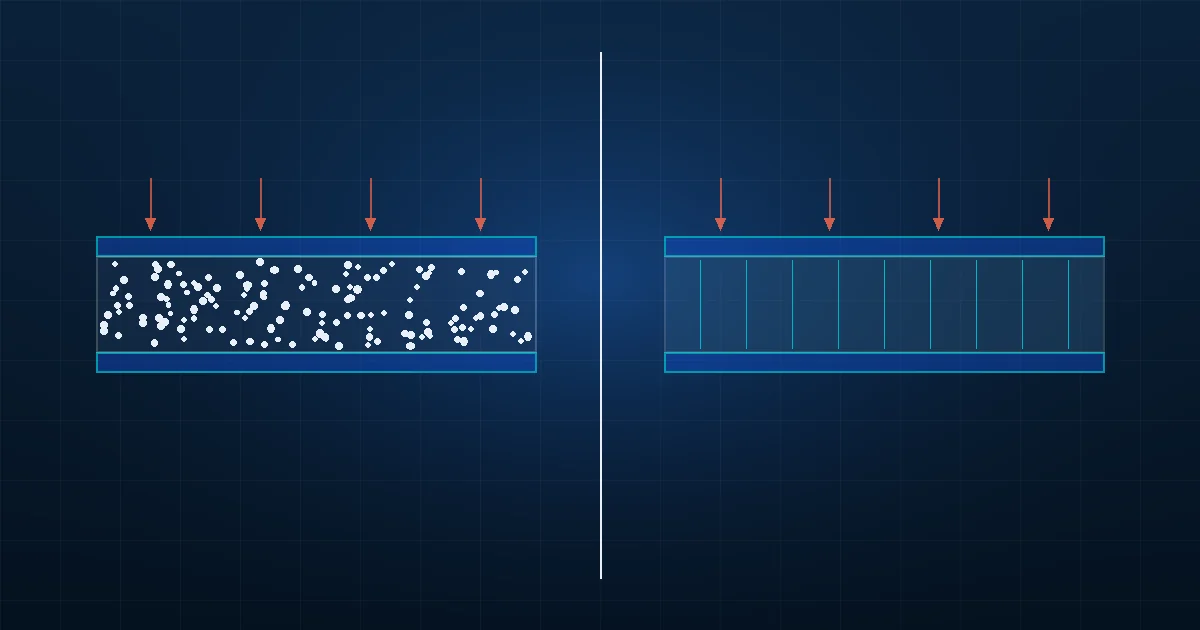
Most thin pressure sensing films use one of two electrical principles. Asking a supplier which one they use tells you more about fit than an accuracy figure does, because the two fail in different ways.
Piezoresistive: resistance falls under load
Conductive particles in a polymer layer touch each other more often as the layer is compressed, and resistance drops. The structure is simple, the usable range can be wide, and the output tolerates electrical noise. The cost is hysteresis and creep in the layer itself, which is why a per-sheet calibration record matters more here than a tighter datasheet.
Capacitive: the distance between two plates
Two electrodes sandwich a compressible dielectric. Load reduces the gap and capacitance rises. Linearity and repeatability are usually better and hysteresis smaller. The trade is sensitivity to humidity and stray capacitance, more demanding electronics, and a range capped by how far the dielectric can compress before it bottoms out.
Three questions worth asking
How much hysteresis at the ends of the range, measured after cycling rather than on the first press? Is there a calibration record per sheet, or only a specification? And what pitch and channel count does the build actually give you at that range? Neither principle wins outright. The answer depends on whether you need range and cost, or repeatability inside a narrow band — and whether the build you are offered exists in that band at your pitch.
The parts this article is about
Compact 4096-point collector
Model: PXS064mini · Dimensions: 90 × 40 mm
Large-format collector
Model: PXS128 · Dimensions: 180 × 180 mm
4096-point sensing film
Sensing principle: Piezoresistive · Thickness: 0.3 mm
One session, all sheets
Platform: Windows desktop application · Input: Multiple collectors via docking hub