Does a 0.3 mm sensing film change the interface it measures?
Inserting a sensing film into a clamped joint adds thickness and stiffness to the load path. The reading is real — it is just the pressure of a slightly different assembly.
PDRELTEST engineering · 2 min read · 2026-10-27
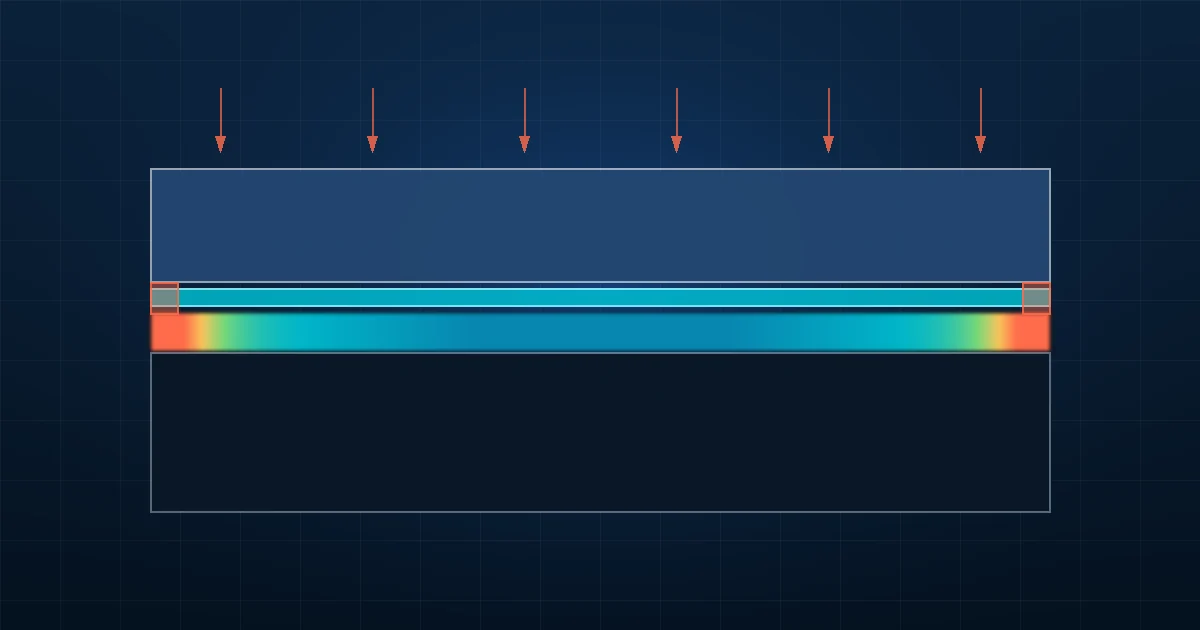
A sensing film is not a passive observer. It sits in the load path, adds a layer of known thickness and unknown compressive stiffness, and reports the pressure of an assembly that now differs from the one you set out to measure. That is not a reason to avoid it. It is a reason to know which numbers survive the perturbation.
What the film changes
Two things. It opens the interface by its own thickness, so a displacement-controlled process — vacuum bag, fixed-gap press — spends part of its closing travel on the film instead of on the joint. And it adds stiffness: where the film is stiffer than the interface it takes load and shows a peak that is partly an artefact; where it is softer it spreads load and returns a flatter map than the joint really has.
The sealed edge is where the error concentrates
The sensing area is 0.3 mm thick. The seal around it is not, and on a clamped joint that seal is a step in stiffness sitting at a location where the surface is already discontinuous. Edge readings therefore trend high on hard interfaces. Trimming the sheet so the seal falls outside the contact patch removes most of it — the same geometry problem as a flat film on a curved blade surface.
How to keep it usable
Compare, do not reproduce. One film build, one placement, one press cycle, then read the difference between two assemblies. That difference survives the perturbation because both sides carry it. For absolute values, pair the map with a load cell on the same test and check that the integrated total matches the applied force — if it does not, the film is telling you about distribution, not about magnitude.
When the effect is small
On soft interfaces — rubber pad, uncured adhesive, breather — a 0.3 mm layer is a small fraction of the total compliance and the reading sits close to true. On steel against steel at high preload the same layer is a large fraction, and above 6 MPa the standard build is out of range in any case. The honest claim is not that a thin film measures an interface exactly. It is that the film is the only way to see the shape of the contact, and the shape is what separates a good part from a marginal one.
The parts this article is about
Related technical articles
On a curved blade surface, a flat sensing film reads low at the edges
A flat sheet cannot follow blade curvature. It contacts at the crown, bridges at the edges, and
Clamping pressure across a blade scarf repair: the toe does the damage
A scarf repair is bonded under vacuum bag or clamps, and the work instruction names one pressure
Piezoresistive or capacitive: two ways a pressure film can work
Both are thin, both produce a pressure map. They differ in what they are good at — and in how th